

By Ian Karbal | Pennsylvania Capital-Star

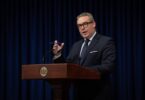
U.S. Education Secretary Linda McMahon joined Pennsylvania Congressman Scott Perry (R-10) and a group of Republican state lawmakers in Harrisburg to advocate for the commonwealth’s participation in a federal school choice program.
“For far too long, many Americans have been shackled to inadequate and failing schools where students fail to reach basic proficiency remarks,” McMahon said at a press conference in the Capitol Friday.
The Trump administration’s Education Freedom Tax Credit program would allow Pennsylvanians to receive federal tax credits of up to $1,700 for making contributions to Scholarship Granting Organizations, which have to be approved by the state.
Those organizations would in turn fund scholarships for private or religious schools, private tutoring and other educational programming for qualifying students, including those enrolled in public schools.
Families making up to 300% of the median income where they live can qualify to receive scholarships. That accounts for roughly 90% of K-12 students in Pennsylvania, according to the Commonwealth Foundation, a conservative- and libertarian-leaning think tank.
But the program requires Gov. Josh Shapiro’s opt-in. Though he’s historically expressed support for school choice programs broadly, he has yet to enroll the commonwealth in the federal program, which was created as part of 2025 Working Families Tax Cuts Act.
McMahon said the program will not cost the state money. But, critics say it effectively diverts federal tax money to private and religious schools. And because public schools are funded in part based on enrollment, it could cost them if students transfer to private institutions.
Pennsylvania does have two state programs offering tax breaks to businesses that fund private school scholarships, the Opportunity Scholarship Tax Credit and the Educational Improvement Tax Credit.
Speakers at the press conference called on Shapiro to opt Pennsylvania into the program. Twenty-seven states already have.

Credit: NBC News
“I believe it’s unfortunate that despite this vigorous, widespread support, Gov. Shapiro has hesitated to voice his support for this transformative program,” McMahon said.
She noted roughly 80,000 applicants were turned away from the state’s existing tax-credit scholarship programs in the 2022-2023 school year as proof of how additional federal funding could help Pennsylvanians. She also cited a 2025 poll commissioned by a group called Democrats for Education Reform that found 78% of Pennsylvanians support opting in to the program.
Perry noted Shapiro’s history of supporting school choice as a gubernatorial candidate in 2022. However, Shapiro ruffled feathers with Republicans in Harrisburg when he vetoed funding for a school voucher plan in 2023, when House Democrats objected during budget negotiations that year.

“This needs to be a priority for a governor, who, by the way as you all know, promised us — promised us on the campaign trail … that we would have the choice of how our children are educated, and where they’re educated, and not be relegated to a failed school district,” Perry said.
Advertisements
He cited a U.S. News and World report that ranked Pennsylvania 39th in education out of 50 states.
State Rep. Martina White (R-Philadelphia) discussed her own history as a Catholic school student.
“I was just another Catholic school kid from Northeast Philadelphia,” she said. “But looking back now, I understand something much more clearly: That opportunity didn’t just happen. My parents made sacrifices. They made deliberate choices about how to spend their money and what to prioritize because they believed it would give their children the best chance to succeed. And they were right.”
Shapiro, for his part, has said that his office is standing by for details from the Trump administration before making a decision on whether to opt Pennsylvania into the program.
“The Shapiro Administration is awaiting federal guidance to address key questions about how this program would work, including which students will be eligible, how this federal initiative will interact with existing programs, and more,” his office said in a statement. “We look forward to reviewing that guidance.”
Susan Spicka, executive director of Education Voters PA, a nonprofit that advocates for public schools, told Chalkbeat last month it would be “wildly irresponsible” for Pennsylvania to opt in to the program before the U.S. Treasury outlines rules for how the program will work. She said such rules could ultimately determine whether or how much the program will ultimately cost taxpayers.
The deadline for governors to opt in to the program for the 2027-2028 school year is January 1, 2027.
Pennsylvania Capital-Star is part of States Newsroom, a nonprofit news network supported by grants and a coalition of donors as a 501c(3) public charity. Pennsylvania Capital-Star maintains editorial independence. Contact Editor Tim Lambert for questions: info@penncapital-star.com.