



Credit: Ed Mahon/Spotlight PA
Part 2 of 2 | Read Part 1 here
After her son’s fatal overdose, Cyndi Compton wanted action.
She took to the streets of Tioga County, putting up signs in the rural community. They sent a clear message regarding Isaiah’s death and others like it.
“It is TIME WE hold DRUG DEALERS Accountable,” read one.
“Ask your County District Attorney why Drug Dealers are getting away with MURDER,” read another.
She searched for information that would help investigators and pushed for changes in her community and across the state. She became known as a relentless advocate.
“I don’t know how she kept on going,” her husband, Thad Compton, said in court years later.
Her search for justice offers a window into the complicated on-the-ground reality of treating overdoses like homicides.
Credit: Ed Mahon/Spotlight PA
Advertisements
Some prosecutors, lawmakers, and families have embraced a criminal charge known as drug delivery resulting in death. The felony is punishable by up to 40 years in prison in Pennsylvania, and is used for cases when someone illegally provides drugs that cause someone to die — it includes both selling and giving.
Critics of the law, including families, defense attorneys, and public health advocates, have objected to its reach, saying the statute does more harm than good and frequently ensnares fellow drug-users instead of large-scale dealers.
Pennsylvania saw a dramatic increase in these charges, after a change in state law and the rise of the opioid epidemic. It is known as one of the top states, if not the leader, for this type of prosecution.
Advertisements
But prosecution rates vary widely between counties here. And compared to the total number of overdose deaths, charges and convictions remain relatively rare. What happens after a death can come down to how local law enforcement decides to approach these cases and the resources they have to investigate them.
In 2020 — the year Isaiah died — Pennsylvania had more than 5,100 overdose deaths.
The same year, state court data show there were about 190 new drug delivery resulting in death charges filed.
Advertisements

Eventually, a grand jury investigation into Isaiah’s death led to drug delivery-related charges against a person — Dayton Wood, now 29 years old. Wood wasn’t a stranger to the family. He and Isaiah grew up in the same community. Years earlier, Thad coached both Isaiah and Wood in football.
Wood was also charged following an investigation into another person’s overdose death: Carl Sargent, who died in 2019, a year before Isaiah. Wood’s defense attorney later described his client as friends with both Isaiah and Sargent.
In both criminal cases, by the time Wood faced charges from the Pennsylvania Office of Attorney General, the two-year statute of limitations for drug delivery resulting in death had expired. He faced other counts.
Advertisements


In October of last year, Cyndi was waiting for Isaiah’s case to resolve. She wanted Wood to spend time in state prison — even if it was just a year.
And there was something else she wanted.
“I would love for him to tell me, ‘I’m sorry,’” she told Spotlight PA. “But I know that’s probably not going to happen.”
Connecting with others
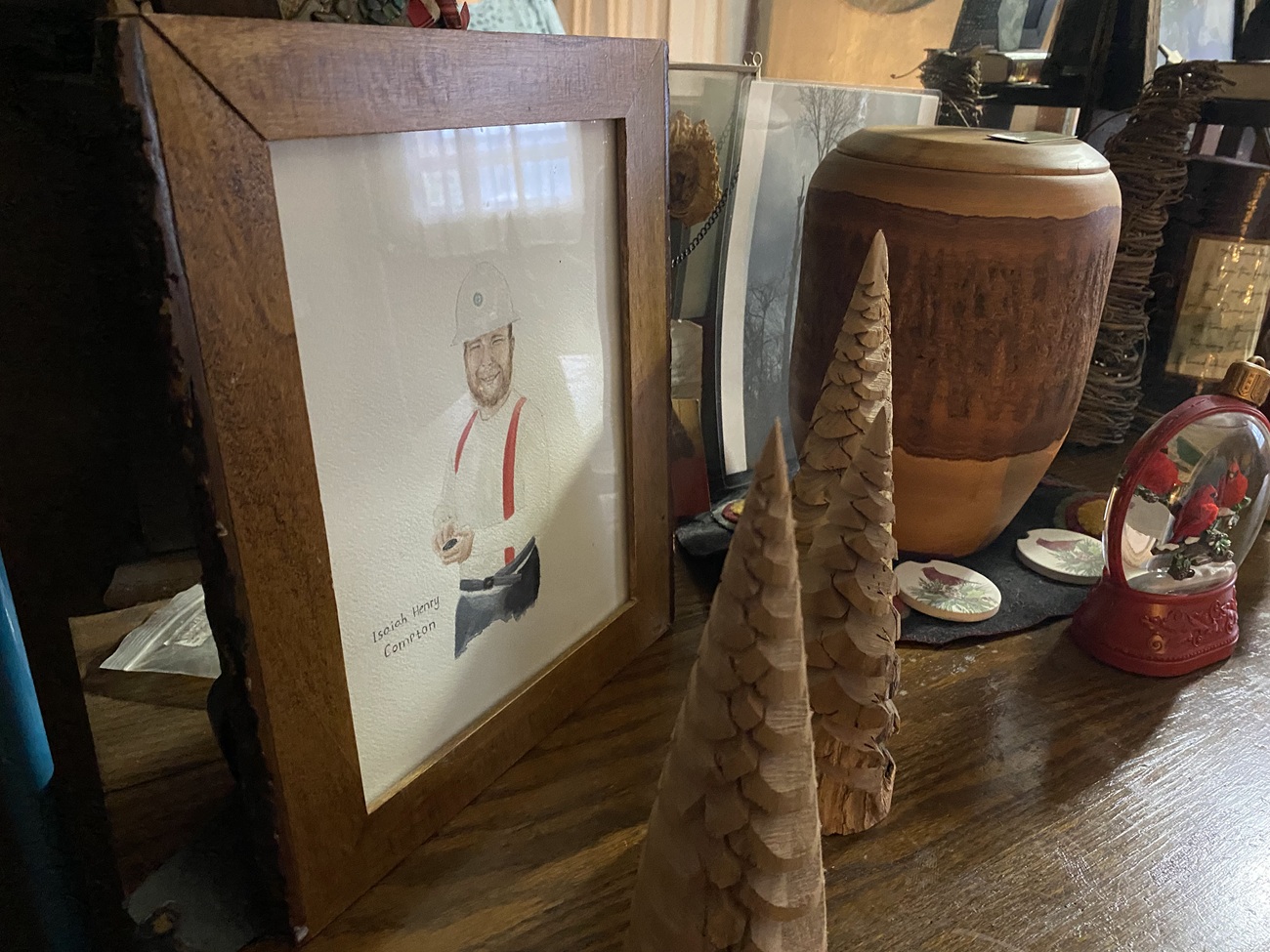
Near the front entrance to Cyndi and Thad’s home in Mansfield Borough, the family has set aside space to honor Isaiah, with photos, mementos, and his urn.
Advertisements


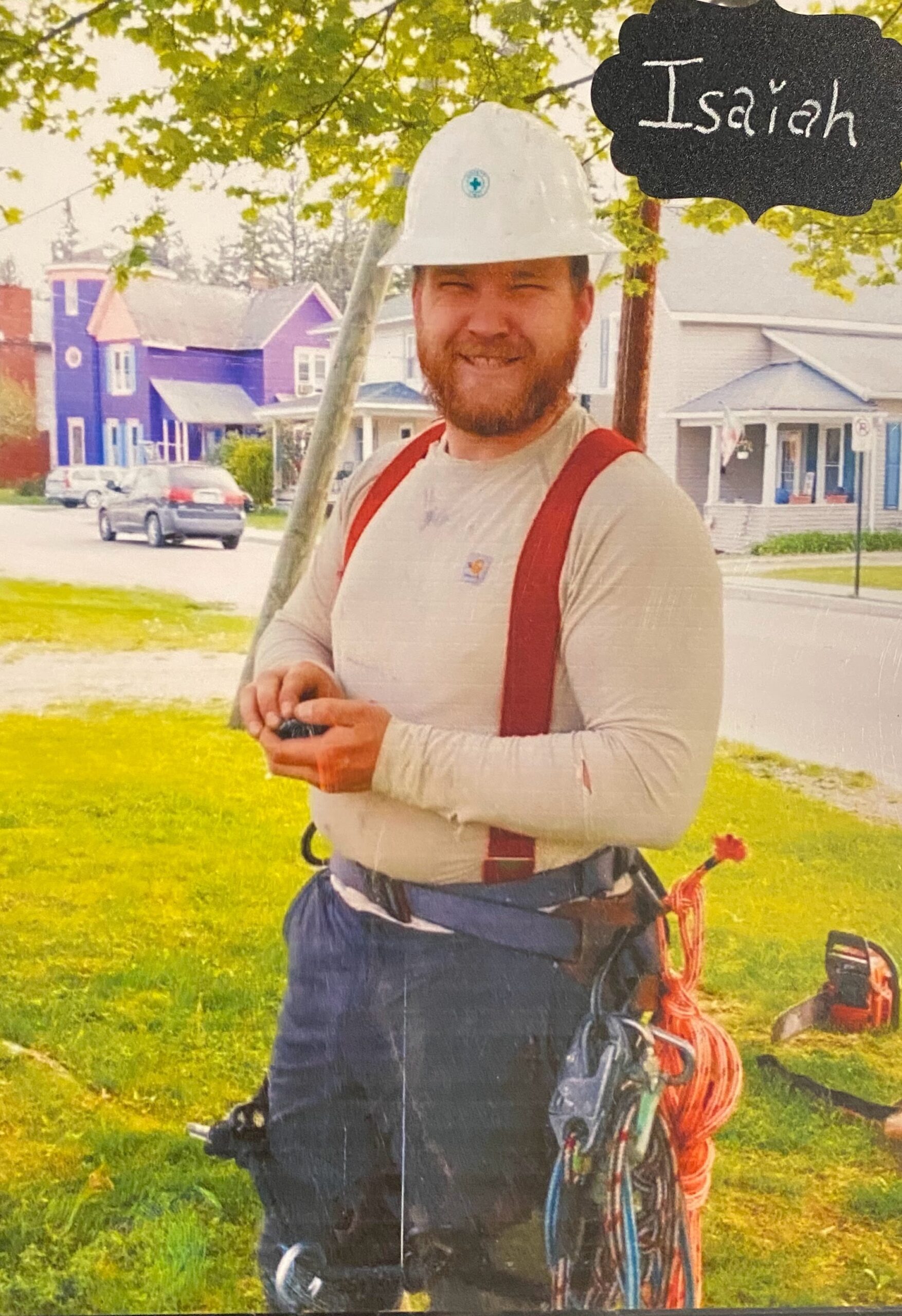
When Cyndi, 62, thinks about Isaiah, she recalls how he had “the prettiest blue eyes,” the ability to light up a room, and a good sense of humor. The former offensive lineman liked hands-on work, and became an accomplished arborist. He was comfortable climbing up high, cutting off branches, and taking trees down in sections.
“He loved it,” she said.
Credit: Ed Mahon/Spotlight PA
Thad, 58, described years of grief. He regretted not taking a photo of Isaiah on “a beautiful fall day” they spent together, shortly before his death.
At the time of Isaiah’s death in October 2020, Thad worked as a county probation officer. He felt he had to distance himself from the investigation — he didn’t want “anybody saying I was trying to influence” anything, he told Spotlight PA. “I just don’t operate that way.”
But Cyndi became a public advocate. Her fight ultimately grew bigger than Isaiah’s case, spreading across Tioga County.
The rural community of about 41,000 residents lies in north-central Pennsylvania, bordering New York state. The county seat of Wellsboro is known for its charming downtown and gas-lit streets. A local business chamber boasts the area has hundreds of miles of hiking and biking trails nearby, including rugged mountain terrain. The lumber industry has historically been big for the county, and Tioga State Forest still hosts active timber harvests and natural gas drilling sites.
Like many parts of Pennsylvania, this rural community saw a rise in overdose deaths as the opioid epidemic spread.
Advertisements
Rhonda Moore, mother of a Tioga County overdose victim, told Spotlight PA, the epidemic “just went crazy, crazy” in the area. The death of her 23-year-old daughter, Jenna Moore, eventually led to a prosecution.
“It was everywhere. … I live so far out in the woods, but it doesn’t even matter,” she said. “It finds you or they find it.”
State court data show one drug delivery resulting in death prosecution and no convictions on the charge in the county from 2015 through 2020. The one time Cyndi found that it was charged locally — in a case involving the death of a newborn — she didn’t think it fit the definition of the crime.
After Isaiah’s death, she wrote a letter to the editor in a local paper, questioning why the district attorney and police weren’t using the charge against drug dealers.
“With the rising number of overdose victims, I believe the law is very clear,” she said in the 2020 letter. “These drug dealers must be prosecuted and held to the letter of the law.”
In January 2021, Cyndi created a Facebook group: “No More Victims of Overdose in Tioga County Pennsylvania.” She described her attempts to contact local leaders, pointed to prosecutions in other counties, and criticized what she called plea deals “for drug dealers over and over and over again.” She also posted about grief support meetings.
Her messages resonated with others.
Beverly Wesneski, the mother of an overdose victim, said the group connected her with people who had suffered a similar tragedy. “When you’re on there, you feel like somebody’s listening to you,” she told Spotlight PA.
But by late 2022, time had run out in Isaiah’s case for a drug delivery resulting in death charge under Pennsylvania law. The two-year statute of limitations was up.
Challenges to prosecutions
Some Pennsylvania prosecutors and lawmakers have raised concerns about the two-year time limit for bringing these drug delivery resulting in death cases.
“District attorneys have come to us and said, ‘That’s just too short of a period of time sometimes for what these investigations entail,’” Kelly Callihan, executive director of the Pennsylvania District Attorneys Association, told Spotlight PA.
She described several challenges to these prosecutions.
Counties might not be able to afford to autopsy every overdose death. It can also be hard to prove that not only did someone deliver drugs — but that those specific drugs led to someone’s death, especially when multiple substances are involved. Moreover, some agencies have less experience investigating these cases and fewer existing relationships with confidential informants.
Another challenge can be overcoming some jury members’ beliefs that the person who died assumed the risk by taking an illegal substance, according to Callihan. She said witnesses are generally uncooperative, and the investigations — particularly if they involve a grand jury — can be lengthy.
Callihan’s organization supports legislation that would increase the statute of limitations to five years for these prosecutions to begin. That’s the time period for a number of drug offenses, including possession with intent to deliver heroin or fentanyl. State Rep. Dane Watro (R., Luzerne), a lawmaker pushing for the extension, said it would address a “legislative oversight.” Citing district attorneys and their statewide association, he said the current time limit “has hampered the prosecution of various serious cases.”
But on the other side of the courtroom, the idea causes concern.
The Public Defender Association of Pennsylvania opposes expanding the state’s crimes code, Executive Director Sara Jacobson told Spotlight PA. She said a “commonsense approach to improving” the state’s drug delivery resulting in death law “would add in clear protections for people who share and use drugs together, without extending the statute of limitations.”
Amanda Jones, a private criminal defense attorney based in Dauphin County, told Spotlight PA that long prosecution windows cause multiple problems for defendants, including creating constant anxiety.
“You’re living in years of uncertainty,” said Jones, who has represented defendants in drug delivery resulting in death cases. “You can’t move forward in your life because you have this hanging over your head.”
As time goes by, key witnesses might move away, become difficult to locate, be more reluctant to testify, or even die, according to Jones. She said it can also become harder for witnesses, including the people accused, to recall specific details of what happened — creating concerns about unreliable testimony.
State Rep. Emily Kinkead (D., Allegheny) has previously raised concerns about the state’s drug delivery resulting in death law and backed legislation to limit its use.
She told Spotlight PA that because the law is broadly written, prosecutors use the charge to punish people “who co-use drugs with someone or who shared their drugs with someone and happened to survive.” This can discourage people from calling for help that could save lives, she warned.
Unless lawmakers narrow the scope of the law to target dealers, suppliers, and traffickers, Kinkead said “extending or eliminating the statute of limitations is irresponsible and dangerous.”
As of early June, different bills to give Pennsylvania prosecutors more time to bring these cases all awaited action in state legislative committees. None had been brought up for a committee vote.
That included legislation named after Isaiah Compton. The bill, sponsored by state Rep. Clint Owlett (R., Tioga), would eliminate the statute of limitations entirely following an overdose death.
His bill would reduce other potential barriers to prosecution, including when multiple drugs are involved. But it also attempts to address concerns about the law being too broad and used against friends who share drugs. It would add a defense that Owlett says is meant to shield people “who are not dealing drugs in return for profit or services.”
Cyndi has urged lawmakers to act on Owlett’s legislation, saying the two-year limit has allowed people to evade accountability for deaths.
“A Drug Dealer behind bars is much less likely to cause a Death,” she wrote to lawmakers.
Frustration in the community
In Tioga County, Cyndi focused on replacing the district attorney, Krista Deats. Deats had worked in the office for years and was first elected to the position in 2015.
In February of 2023, Cyndi urged registered Republicans to sign a petition for Deats’ challenger, attorney Sandra Olson. The same month, news reports described charges against Travis Ott, a defendant in a Tioga County drug delivery resulting in death case. The victim in the case was 23-year-old Jenna Moore.
For Cyndi, it was too little, too late. “While this is fantastic news, let us not forget the 40+ people who lost their lives with no justice under Krista Deats’ reign as District Attorney,” she wrote on Facebook. “And, surprise – it’s election year.”
Politically, Tioga County is solidly Republican, and Olson and Deats were both competing for the GOP nomination. Ahead of the 2023 primary, there was no Democratic candidate for district attorney on the ballot.
During the campaign, both candidates identified drugs as a major issue in response to questions for an article in the Wellsboro Gazette.
Deats wanted to continue “the push of prosecutions involving controlled substances in our communities,” she said. She highlighted a county treatment court program, money seized through “the successful prosecution of many drug offenders,” training for officers, and work in schools.
Olson said she would “focus additional resources on the illegal drug epidemic,” pledged to “support law enforcement with education and resources to bring drug dealers to account,” and described speaking with mothers of children who died from an overdose. “I will work diligently to address this issue on all fronts,” she said.
Olson ultimately swept both contests, winning more than 61% of the Republican vote. For the Democrats, she received 335 write-in votes — enough for a victory there, as well.
“There was a sense that Deats was not performing the role the way they were supposed to. … People were dissatisfied,” Gabe Hakvaag, chair of the local Democratic committee, told Spotlight PA.
For Cyndi, it was a victory.
That fall she celebrated another Tioga County drug delivery resulting in death charge, this time against defendant Jaden McGee.
“Things have changed so much in the last 3 years,” she wrote on Facebook. “Better watch out drug dealers – they are coming after you too!”
But securing a conviction on drug delivery resulting in death charges proved complicated in Tioga County.
Different versions in court
As a candidate, Olson highlighted a diverse background, including working as a registered nurse and an attorney, and serving as an ordained minister. During the campaign, she raised alarm about drug overdoses in the county and the lack of prosecutions for drug delivery resulting in death. She called the situation “completely unacceptable.”
“We must fix this problem,” she said.
She took office with the Ott and McGee drug delivery resulting in death cases still pending. Both became early tests for Olson.
Each case led to a plea deal, highlighting the challenging nature of bringing these types of charges and the different versions of events that can emerge in courtrooms.
Transcripts obtained by Spotlight PA bear this out.
In McGee’s case, police accused her of delivering fentanyl that caused the death of 27-year-old Jaguar Gordon. In a criminal complaint, police cited Facebook messages and video surveillance footage as evidence.
The district attorney’s office, under Olson, ultimately dropped the charge of drug delivery resulting in death. McGee pleaded guilty to two felonies: criminal use of a communication facility and a possession with intent to deliver charge.
At the August 2024 sentencing hearing, Olson argued for a tougher sentence than the standard range, saying McGee “agreed that she delivered fentanyl to a victim and the victim died.” The defense attorney argued otherwise, saying there was “no indication that she sold him anything that day whatsoever.”
McGee received a prison sentence of at least 12 months — on top of a sentence she was already serving in another case, which Olson argued for. McGee also was given credit for time already served.
In the other Tioga County drug delivery resulting in death case, Ott entered what’s known as an Alford plea for voluntary manslaughter — he maintained his innocence but accepted the penalty. The district attorney’s office dropped the drug delivery resulting in death charge.
At the July 2025 sentencing, Olson described how the death of Jenna Moore left behind two young children now being raised by Moore’s mother, Rhonda. She also highlighted the number of Pennsylvanians who die each day from an overdose, and acknowledged the limits of putting one person in prison.

“Law enforcement is working diligently to find those who are selling the drugs and thwart their efforts, but prosecution is not going to solve this problem,” she said. “The defendant, Mr. Ott, will be replaced by someone else.”
Ott declined to make a statement at the hearing. He received a minimum sentence of over six years, with credit for time already served.
The families continue to deal with the impact of the deaths.
Gwendolyn Burdick, Gordon’s mother, wanted a longer sentence in McGee’s case. “Twelve months is — it’s a slap in the face when my son is dead,” she told Spotlight PA.
Rhonda Moore told Spotlight PA she doesn’t know if she’ll “ever be right again,” following Jenna’s death. She was relieved after Ott’s conviction.
“I felt lucky that anything was done honestly, ’cause I’ve known a lot of people around here that lost their children, and there was nothing,” she said. “There was no justice at all.”
Disappointment with the new DA
The McGee plea deal frustrated Cyndi. She’d spent a lot of time and energy helping get Olson elected, and thought things would be different.
“Keep letting drug dealers off on lesser offenses….. Exact same as the last DA,” she posted online in August 2024. “I am so very disappointed!!”
She followed up with a simple message: “Do you ever feel used?”
Olson defended her record. She told Spotlight PA she’s working to meet the goals she set during her campaign, and believes “in a two-prong approach to prosecuting drug cases.”
Law enforcement must address both the supply of drugs and treatment for people addicted to substances, she said. She described herself as an advocate for treatment court programs, and said people who deliver drugs “on a regular basis and in large amounts must be prosecuted and sent to prison.”
Citing statewide data, she also said drug delivery resulting in death cases and convictions decreased from 2023 to 2024. The rise in the “use of methamphetamines instead of heroin and fentanyl which are more likely to cause overdose deaths” may be a factor in the drop, she noted.
Regarding plea deals, Olson considers “a myriad of variables.” She told Spotlight PA that Ott’s sentence for voluntary manslaughter was consistent with a drug delivery resulting in death sentence, and said McGee received a state prison sentence. An additional drug delivery resulting in death case was filed in early January in the county, she added.
“Since I have taken office, we have been diligently working on the drug issue in our county,” Olson said.
By last year, Cyndi was less critical of Olson. Reflecting back on her public comments on the McGee case, Cyndi talked about the toll of grief and told Spotlight PA, “When I get down, I get way down … over these things.”
She recalled how, before Isaiah died, she worked with a parent who had lost a child. At the time, Cyndi was struck by how — even though the death occurred two years earlier — the loss remained vivid for the parent, as if it had just happened. That makes sense to Cyndi now.
“Until you’ve been in somebody else’s shoes, you don’t understand,” she said.
Cyndi still wished McGee had faced a longer sentence. But she thought Olson was bringing attention to these issues and getting more done than the prior district attorney.
“I know her heart’s in the right place,” Cyndi said in October.
Several months later, Cyndi said she admired Olson — and expressed a measure of regret over her earlier criticism of the current district attorney. “It’s not an easy, cut-and-dry job,” Cyndi said. “And I should keep my mouth shut sometimes.”
Credit: Ed Mahon/Spotlight PA
Charges years after 2 deaths
Isaiah’s case took a winding path to a conviction.
In 2023, criminal charges were filed in connection to his death, according to court reporting in the Wellsboro Gazette. It was not a drug delivery resulting in death case. The two-year statute of limitations had expired, meaning that charge wasn’t an option. Records of that case are no longer publicly available.
After taking office in 2024, Olson told Spotlight PA she reviewed outstanding cases and it was determined that “the Wood case” would be better for the attorney general’s office, using a statewide grand jury. She said she had to withdraw a Tioga County case for the statewide grand jury investigation to proceed.
Grand juries can be a powerful tool. An attorney general office spokesperson noted they have “subpoena power to compel testimony from otherwise reticent witnesses with key information about criminal conduct.”
In 2024, the attorney general’s office charged Wood in connection to Sargent’s death. The next year, the office charged Wood again, this time in connection to Isaiah’s death. A grand jury presentment called Isaiah’s death “overdose-related” and said it involved fentanyl, cocaine, and other substances.
In both cases, evidence tied Wood to the victims’ drug use. In Sargent’s case, there were phone records, GPS tracking, and app payments of $100 and $160. In Isaiah’s, there were Facebook messages, surveillance footage, an ATM receipt showing an $80 withdrawal, and multiple unnamed witnesses.
One unnamed witness in Isaiah’s case said Wood was their source of “heroin/fentanyl,” that they had traveled with him to obtain drugs, and “that Wood was obtaining multiple bricks of heroin to distribute,” the presentment said. A brick usually has about five bundles — each with about 10 individual packets of “heroin/fentanyl,” the unnamed witness said.
Based on the same witness’ testimony, the presentment attributed a direct statement to Wood after Isaiah’s death: “I just killed my friend.”
In each case, Wood did not face drug delivery resulting in death charges. The attorney general’s office’s “first meetings with local investigators — who had jurisdiction over these cases — were multiple years beyond” the two-year limit, according to agency spokesperson Brett Hambright.
A spokesperson for Democratic Gov. Josh Shapiro, who was state attorney general when Isaiah died, made a similar point, saying local authorities didn’t reach out asking the office to intervene until 2024. Shapiro was governor by then.
Deats, the former district attorney, did not respond to multiple calls, emails, and letters, requesting comment for this story. Robert Hoffa, Wood’s attorney, declined to comment, and told Spotlight PA to “refrain from contacting” Wood or his family.
Choosing what to say
In early November, Wood accepted a deal in each case, pleading guilty to one felony in Sargent’s case and two in Isaiah’s. Other charges were dropped as part of the agreements.
On the day of the guilty pleas, Cyndi and Thad sat in a large Tioga County courtroom. Thad had the feeling of just wanting “to hear your kid’s name connected to Dayton,” he later recalled.
At the hearing — as Wood answered yes to a series of questions from the judge — Wood acknowledged delivering cocaine to Isaiah and conspiring to deliver fentanyl and heroin to him.
The parties agreed to a minimum two-year prison sentence, followed by five years of probation. Wood could be eligible for a drug treatment program while in prison, although the judge noted there were no guarantees he’d qualify.
After the guilty pleas in November, Isaiah’s parents still wished Wood had been charged with drug delivery resulting in death before the two-year limit had passed.
“That’s the only thing that is a little disappointing — is that it’s not that,” Thad said that day. “Because I do think that it needs to be used when it’s appropriate.”
Three months later, friends and family members of Cyndi and Thad showed up to the Tioga County courthouse for Wood’s sentencing.
On that February afternoon, Cyndi wore some of Isaiah’s clothes: a green shirt and bright, patterned socks. In the courtroom, her sleeves were rolled up, making visible her tattoos in memory of Isaiah.
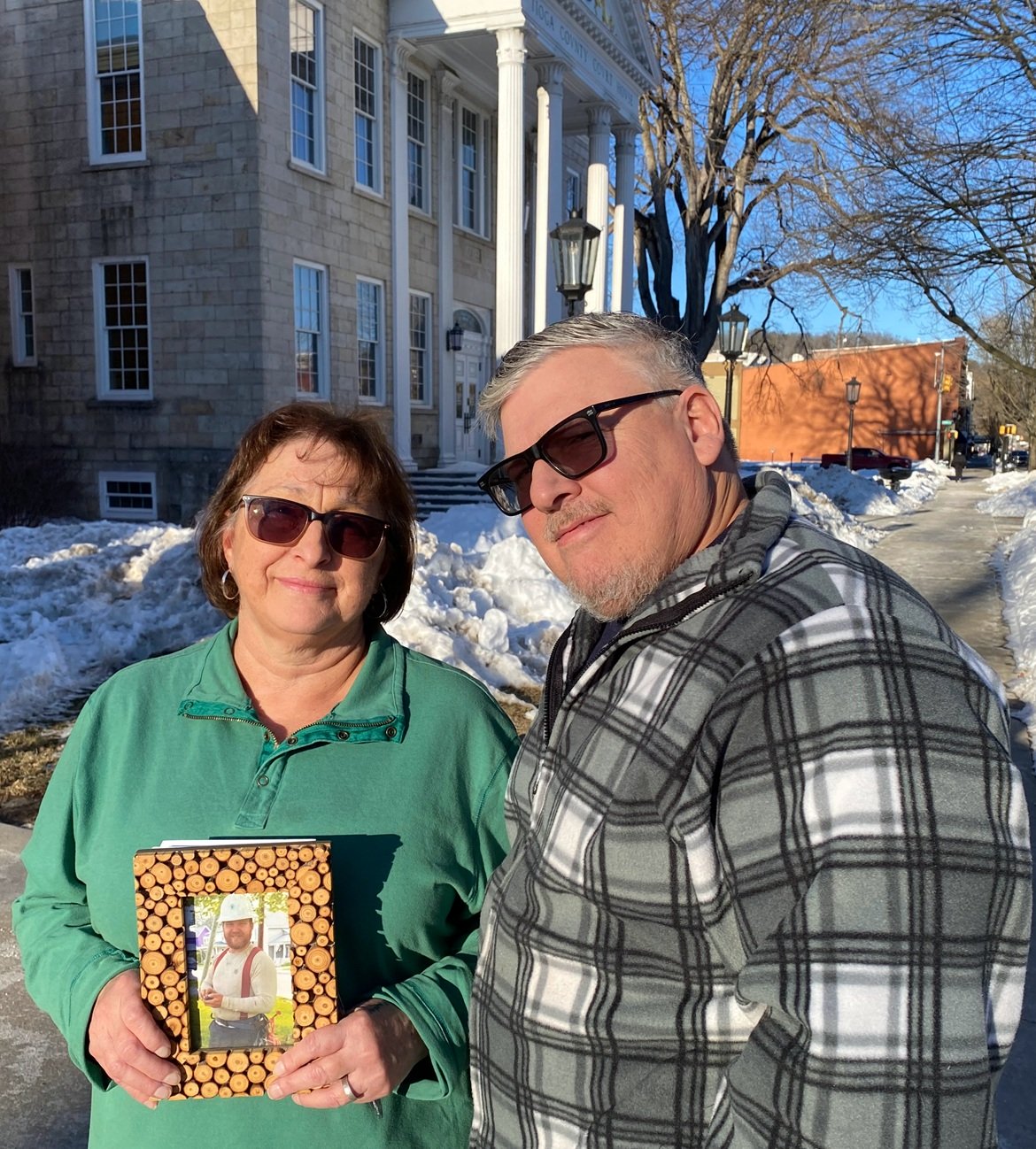
When it was her turn to speak, she brought a framed photo of Isaiah up with her, and made a point to look at Wood.
She described reading Facebook messages involving Wood and Isaiah, saying her son “was trying to help you with jobs and stuff.” Isaiah had been drug-free for about a year and Wood knew he was “vulnerable and in recovery,” Cyndi said in court.
“You did not simply sell drugs, you exploited trust,” Cyndi told him. “You endangered a known recovering individual. You caused the death of my son.”
Thad started his remarks by thanking three people: the prosecutor, a state trooper, and his wife. “Without her, I know that we wouldn’t be here today,” he continued.
Thad recalled coaching Wood and Isaiah in football when they were younger. They had good times — experiences Thad still holds onto, he said, despite the grief of the five years since his son’s death.
The father told Wood that even though it was tough, he forgave him. Thad knew the prison stint would be painful, but wanted it to be a turning point for Wood. He hoped one day Wood would have children — and get to do the things that he was able to do with Isaiah.
“I wish you all the best,” Thad said.
Wood’s attorney, Robert Hoffa, addressed the court and family members. He said his client “does have deep, deep regret for what happened here and apologizes to all of you.” He talked about how Wood was friends with both Isaiah Compton and Carl Sargent.
“It’s unfortunate they were all three doing drugs together at various times,” Hoffa said. “He was an addict as well, and he used the same drugs that, unfortunately, took the lives of those two individuals.”
Wood had gone through rehabs multiple times, Hoffa said. “He wants to take responsibility, he wants to remain sober, and he wants to get on with his life,” the attorney said.
The judge then gave Wood a chance to speak.
“Yeah,” Wood said, “I just want to say to the families that I am deeply sorry.”
He talked about how he had to live with regret, had lost two best friends, and wanted to continue to improve his life. “Again, I want to say that I am deeply sorry,” he said at the end.
The judge issued the sentence in each case, consistent with the plea deals. Thad and Cyndi talked with friends and family members afterward.
Later that day, away from the courthouse, they reflected on the case. The sentencing, Thad said, went as well as he thought it could have. He had once wondered if this day would ever come.
Thad noticed Wood apologized twice, and Cyndi observed that when she looked over at Wood, he looked right back at her.
Their remarks in court had differed. Thad said he forgave Wood, while Cyndi didn’t mention forgiveness. She was, she said afterward, still working on that.
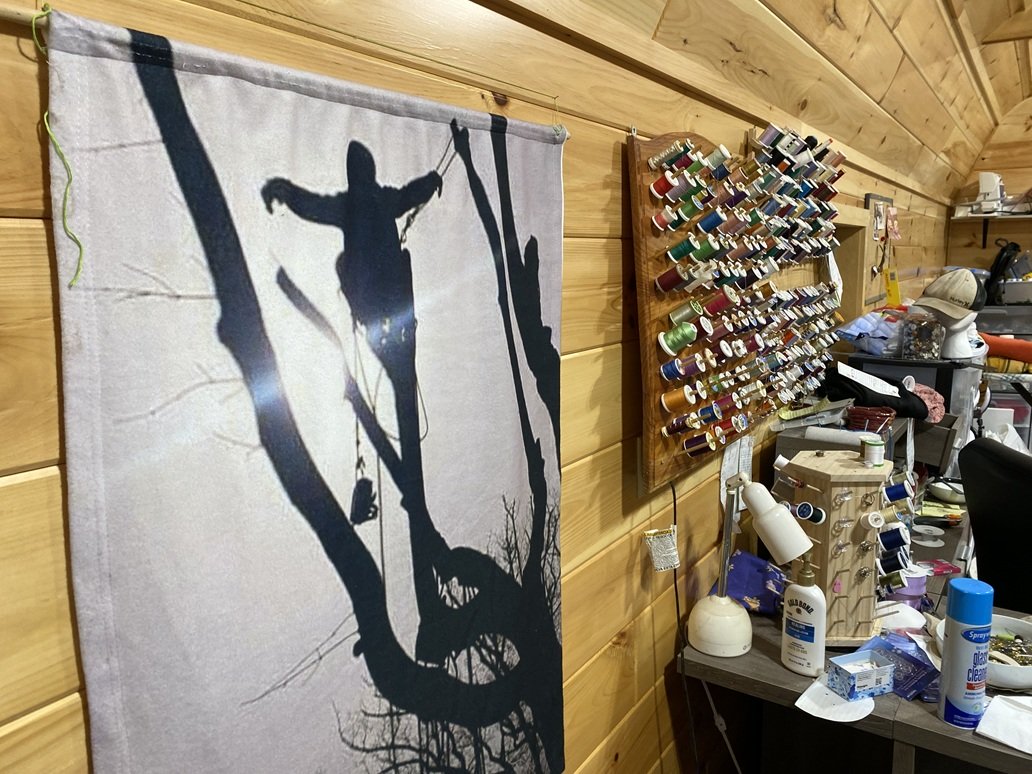
As the months went by, some routines continued. Cyndi has been adjusting to the aftermath of a mini-stroke she suffered last year. She was taking new medications, eating healthier foods, and, she said, wanting “to not get so worked up.” She spends many days in the backyard shed where she works as a seamstress — tailoring dresses, costumes, and other projects for friends, family, and customers. A large piece of fabric showing Isaiah in a tree hangs on a wall, next to spools of thread. He would have turned 30 in March.
She thinks about Wood too. In April, Cyndi learned he was transferred to a state prison that offers an intensive drug treatment program.
Credit: Ed Mahon/Spotlight PA
She was glad, and hoped it would help keep Wood alive: “I don’t want his mom to go through what I’ve been through.”
This investigation was supported with funding from the Data-Driven Reporting Project. The Data-Driven Reporting Project is funded by Arnold Ventures and the Google News Initiative in partnership with Northwestern University | Medill.
BEFORE YOU GO… If you learned something from this article, pay it forward and contribute to Spotlight PA at spotlightpa.org/donate. Spotlight PA is funded by foundations and readers like you who are committed to accountability journalism that gets results.